In-Season Flowers: A Deep Guide to Styling With the Season
A practical deep guide to choosing in-season flowers, matching color and scale to your space, and styling bouquets so each arrangement reads as intentional rather than thrown together.
Flowers that belong to the current season make a room feel current in a way almost nothing else does. This guide walks from fundamentals to a confident decision: how the seasons shape the market, how to read color and scale, and how to style against the room the flowers live in.
What “In Season” Actually Means for a Buyer
Seasonality is a supply signal before it is an aesthetic rule. Flowers that are actively growing somewhere in the world travel shorter distances, hold up longer in the vase, and are usually better value at the moment they peak. Holidays complicate the picture. Demand for Valentine’s Day and Mother’s Day pulls certain flowers into the spotlight whether or not they are naturally at their best, and that pressure shows up in price and in how quickly arrangements sell through.
That is why an in-season mindset is really a reading of the market. Spring leans on bulbs and soft pastels. Summer opens the widest palette of the year. Autumn shifts toward copper, burgundy, amber, and dried texture. Winter narrows again to whites, deep reds, and evergreen structure.
Reading the Seasonal Color Palette
Color is the fastest way to tell whether an arrangement belongs to the month. Spring favors soft peach, pale yellow, lavender, and blush because the light itself is gentle. Summer tolerates saturated pinks, bright corals, and deep greens. Autumn turns warm almost everywhere: copper, gold, rust, plum, and burgundy. Winter pulls back to white, cream, crimson, and cool blue.
Matching that swing does not mean your flowers must match your sofa. It means the arrangement should not fight the ambient light. A deep burgundy bouquet in a north-facing room in July can look heavy, while the same stems in late October look right because the daylight has gone cooler.
Flowers also carry traditional associations: roses with romance, sunflowers with warmth and good wishes, lilies with sympathy in many settings, mums with autumn abundance. These are cultural shorthand, not facts, and they shift with region and recipient.
Choosing Blooms That Actually Flourish Now
Start with what looks alive. Petals should be firm and unwilted, leaves should be green rather than yellowing, and any buds that have not opened should still feel tight. In a clear glass vase, the water line and the cut ends are visible, so freshness is easy to judge on arrival.
Then consider structure. A good seasonal arrangement is rarely a single flower type repeated. It layers a focal bloom, a secondary bloom in a related or contrasting color, and a filler or textural element. That layering keeps a design from reading as flat and stretches your budget, because the supporting stems cost less than the focal ones.
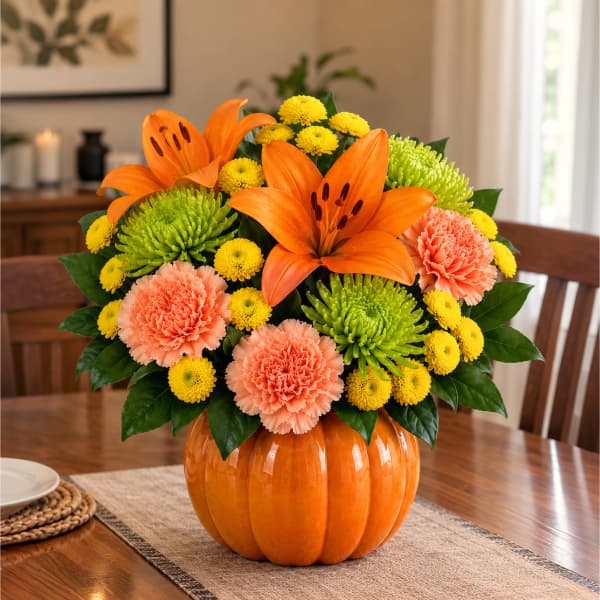
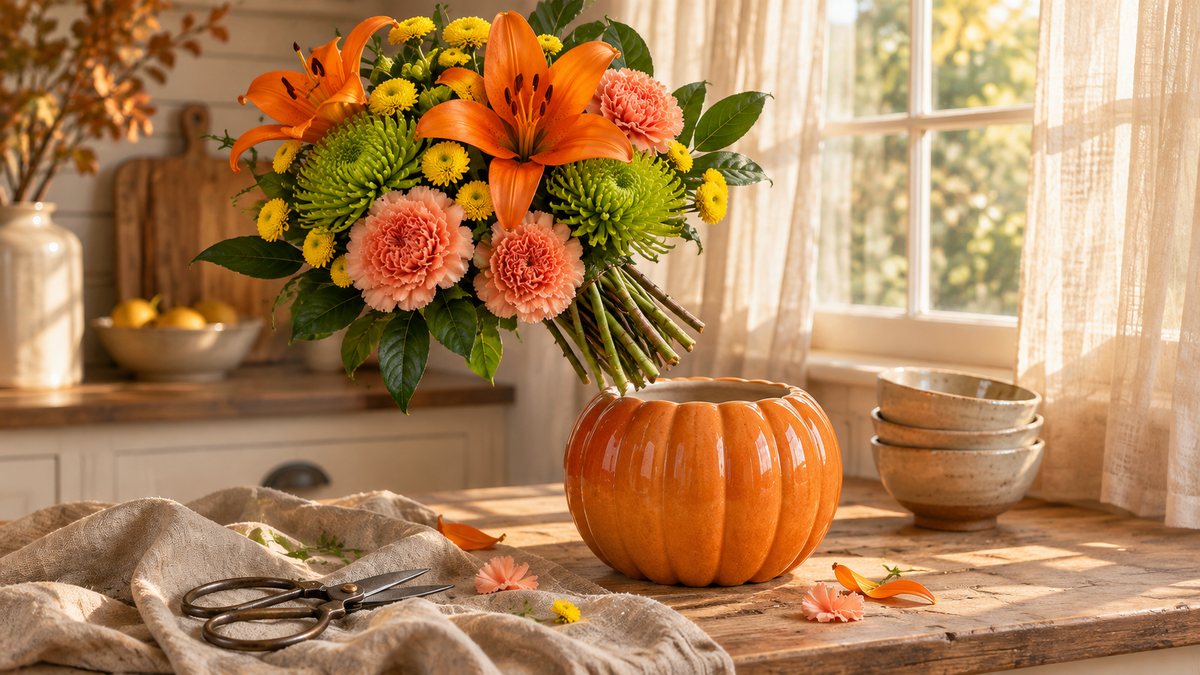
The most reliable seasonal signal is often the container. A glossy ceramic pumpkin vessel signals autumn instantly, and the Golden Hour Pumpkin Arrangement pairs that vessel with orange Asiatic lilies, soft peach carnations, lime-green spider disbud mums, and yellow button poms.
Matching Scale to the Room
Scale is the most common mistake in flower styling. A compact arrangement on a long dining table disappears; an oversized one on a bedside table crowds the lamp and the book stack. Judge scale against the surface and the viewing distance.
Nightstands, bathroom counters, kitchen islands, and office desks all call for a lower, tighter composition. The viewer is within arm’s reach, so detail matters more than volume. A few stems in a small vase read as considered where a large bouquet reads as clutter.
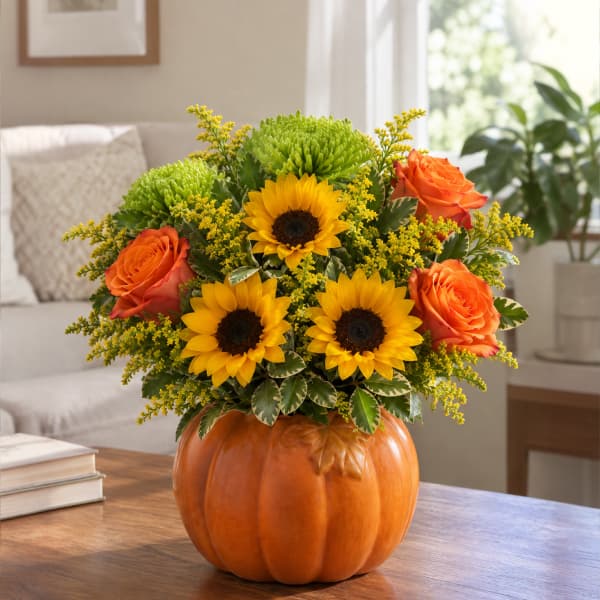
Dining tables, entry consoles, and mantels need height and width to register from across the room. Here a generous arrangement earns its footprint. The Thanks – Cozy Fall Pumpkin Bloom is a strong example: orange roses, bright sunflowers, rich green spider mums, and golden solidago nested inside a ceramic pumpkin vase, with the Premium size adding more presence.
- Keep an arrangement under about one third the height of the tallest object beside it.
- On a dining table, keep the arrangement low enough that guests can see one another across it.
- In an entryway, let the flowers be the first thing seen from the door.
Styling Against Your Backdrop
Before you choose color, look at what is behind the arrangement. A white or cream wall supports almost any palette. A richly colored wall, dark wood, or patterned wallpaper needs a bouquet with enough contrast to separate from it; otherwise the flowers blend into the background.
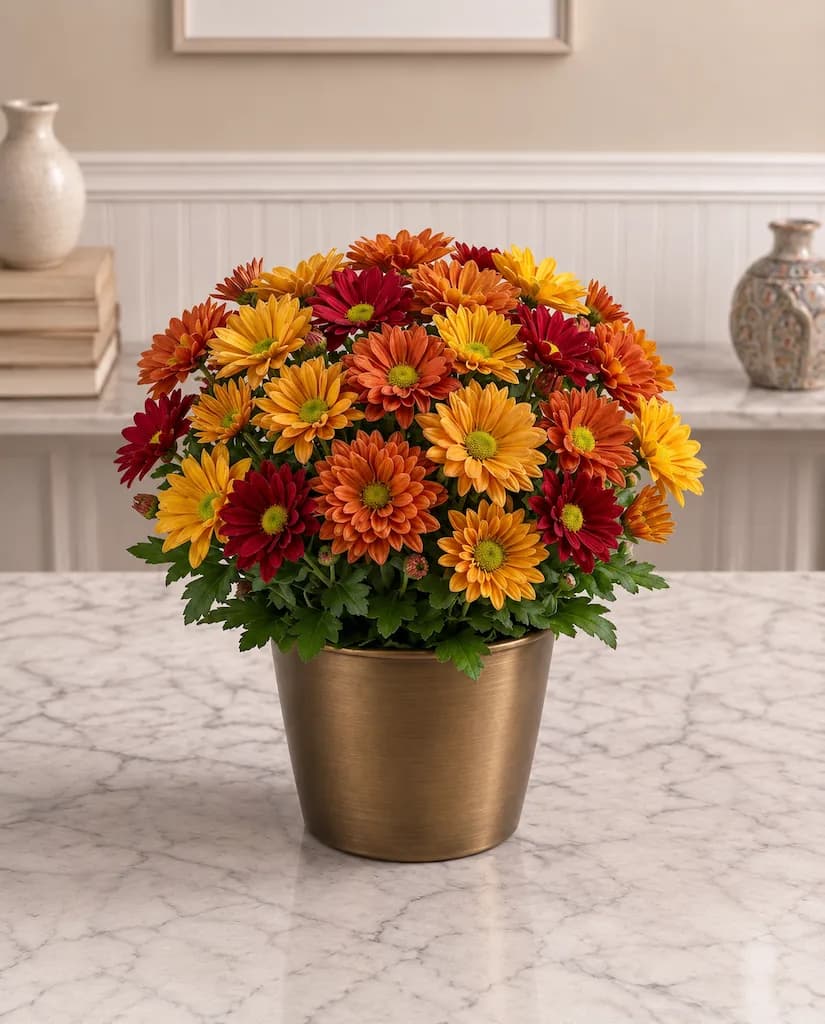
The container is not an afterthought, especially when it is decorative. A terracotta planter, a metallic pot, a woven basket, or a ceramic mug carries as much seasonal information as the stems inside it. An orange potted chrysanthemum in a classic terracotta planter, like the Autumn Elegance Plant, reads as a harvest display even before you notice the bloom color.
Light direction matters too. South-facing rooms get warm, bright light that flatters yellows, oranges, and whites. North-facing rooms get cooler light that flatters blues, lavenders, and deep reds. In a dim corner, choose luminous colors that reflect what little light is available rather than deep tones that absorb it.
Keeping Seasonal Stems Looking Fresh
Seasonal flowers are often hardier than out-of-season imports, but they still need the basics. Start with a clean vase and fresh water, and trim the stems at an angle before arranging so the cut ends can take up water. Remove any leaves that would sit below the water line, since submerged foliage clouds the water.
Change the water every day or two rather than waiting for it to look cloudy. Keep the arrangement away from direct heat, air vents, and full afternoon sun, all of which shorten vase life. In a clear glass vase, the water line is your freshness gauge: when it drops, top it up; when it turns hazy, replace it.
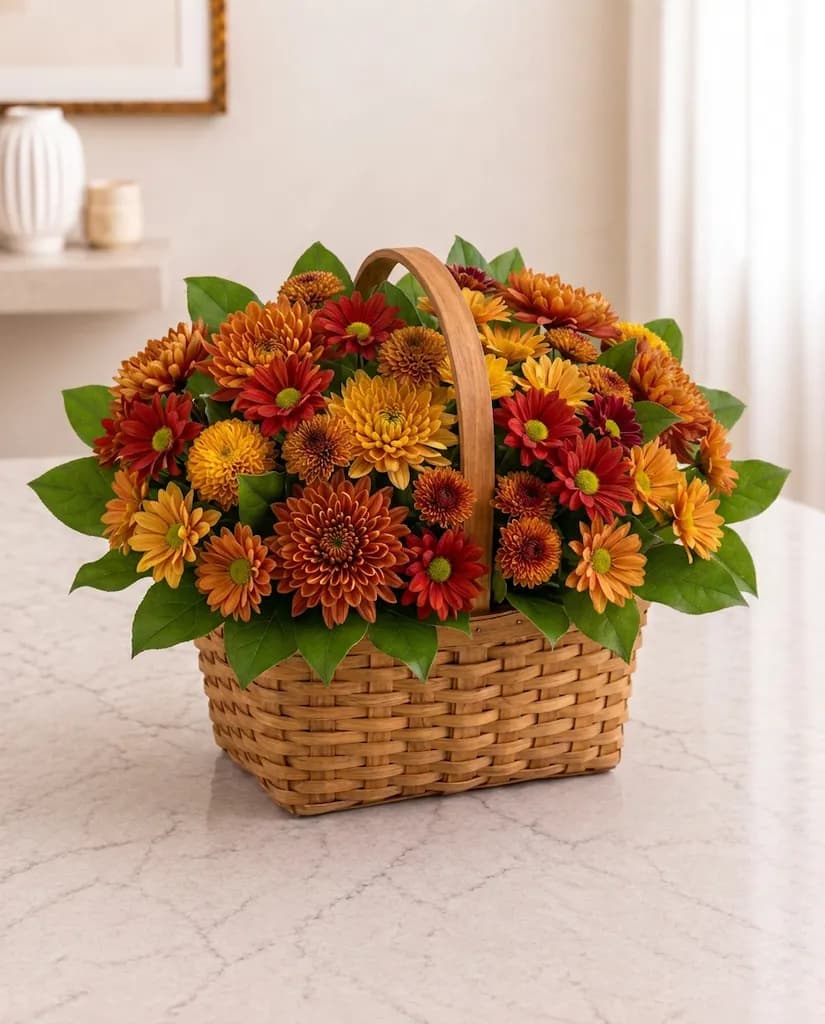
A little structure goes a long way. The Warm Wishes Daisy Basket combines bronze cushion spray mums, orange and yellow daisy mums, and burgundy spray mums in a woven wooden handle basket, and that daisy-form mix holds its shape well even as individual stems fade.
Seasonal Switchovers: Refreshing Without Rebuilding
You do not need a new arrangement every few weeks. A seasonal switchover works better as a rotation of a few elements. Keep a neutral container that works year round, then change the focal blooms and the filler to match the month: pale tulips and soft greens in spring, bright mixed stems in summer, copper and burgundy in autumn, whites and deep reds in winter.
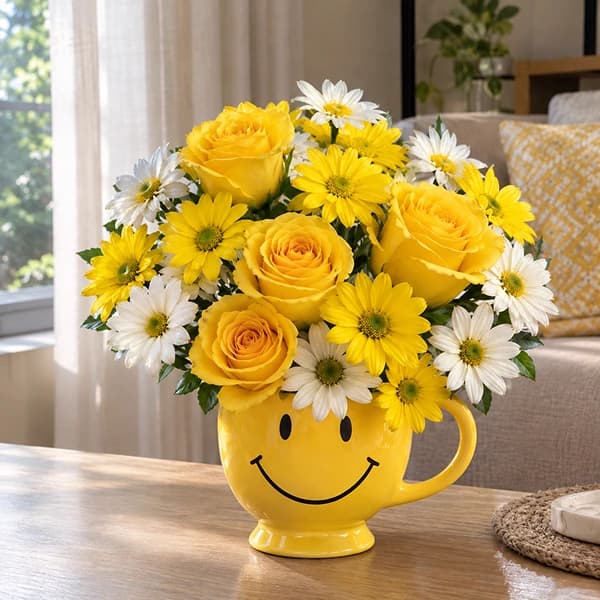
One more element worth rotating is the container’s finish. A metallic pot or a ceramic vessel with a seasonal shape gives the same stems a different read. The Smiles & Sunshine bouquet, with yellow roses, yellow daisy spray chrysanthemums, and white daisy mums in a bright yellow ceramic smiley face mug, is a good illustration: the flowers are cheerful in any season, but the mug makes the whole thing feel like a specific moment.
Timing also matters for gifting. Order ahead of the rush rather than at the last minute, and remember that same-day delivery is available in many areas but depends on local florist availability and order timing.
Making the Final Call: A Decision Framework
When you are standing between two arrangements and neither is wrong, use a simple order of questions. Does it match the season you are actually in this week? Does it fit the surface and the viewing distance where it will live? Does the color separate from the wall and the furniture behind it? Does the container add to the composition or merely hold it? Is it fresh enough to look good for several days, not just on arrival?
Those five questions usually eliminate one option quickly. If both still look good, pick the one that feels less like a purchase and more like something you chose for the person or the room. For more on choosing flowers by color and meaning, see our guide to color meanings, and for a broader approach to personal taste, our beginner’s guide to flower color and style is a useful companion.
Building a Seasonal Flower Habit
The habit is simpler than most people assume. Pick a season. Pick a container that works all year. Rotate the focal blooms with the months. Keep the water fresh and the light in mind. When the arrangement fades, compost it without guilt and start the next one. That small rhythm keeps a home feeling cared for, and it keeps the gesture of sending flowers feeling personal.
For more on timing and planning, our seasonal field guide to milestone flower planning covers the calendar side. Whatever the season, Great Flowers can help you send something that arrives looking like you meant it.