Orchids (Orchidaceae)
Orchids (Orchidaceae) explained: how to recognize the family, common varieties, color meanings, seasonal availability, cut-flower care, design ideas and gifting occasions.
What orchids are and how to recognize them
Orchids belong to the family Orchidaceae, one of the largest plant families in the world. The family holds thousands of species, and growers have crossed many of them to produce even more forms. When people say "orchids," they may mean a living potted plant, a single cut stem, or a spray of blooms in a bouquet. Both are the same family, but they are handled quite differently.
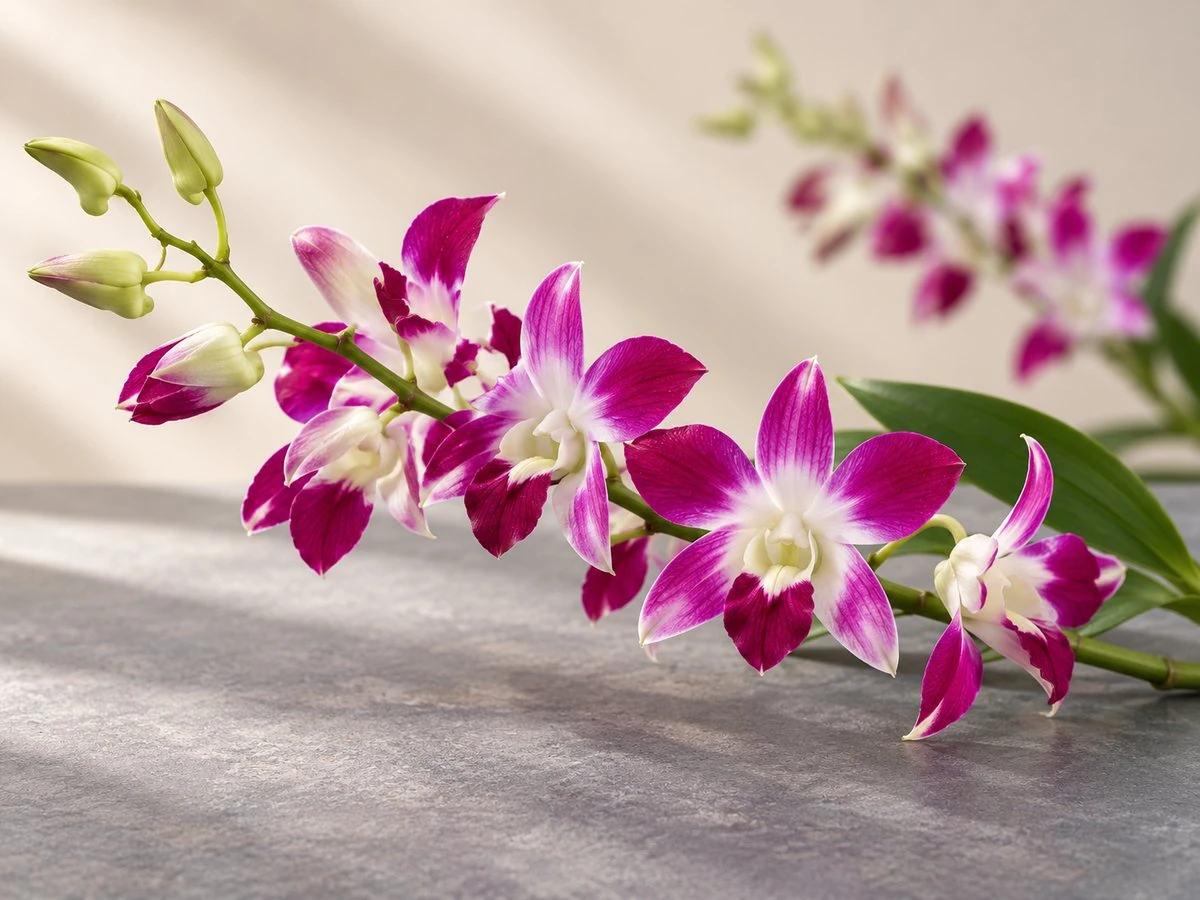
Orchid flowers share a few reliable traits. Three petals sit on the outside and three sepals behind them, and one petal is usually modified into a distinct lip. The flower parts are arranged so that one side is a mirror of the other. Instead of loose dust-like pollen, most orchids carry their pollen in small waxy packets. A thick outer skin on the leaves helps the plant hold water, and many orchids grow on trees or bark rather than in soil. These details are what separate a true orchid from the many unrelated plants that borrow the name.
Common varieties and forms
Most orchids sold as cut stems come from warm growing regions, and several genera turn up again and again in florist work.
- Phalaenopsis: broad, rounded petals on arching stems, often called moth orchids. A common potted and cut choice.
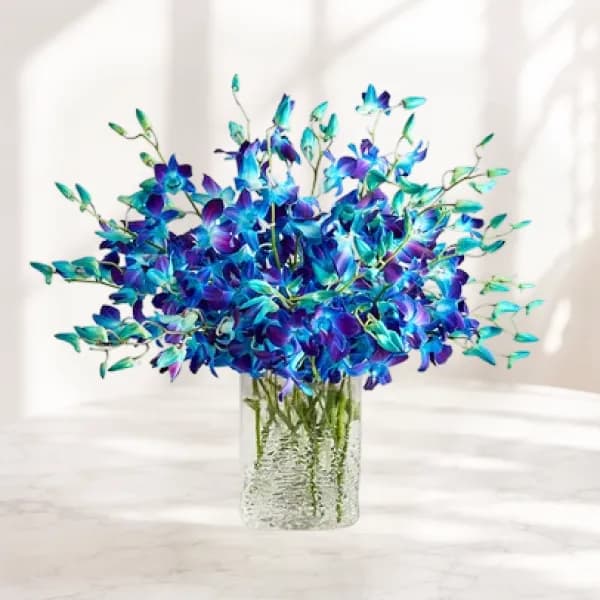
- Dendrobium: slender stems carrying several smaller blooms. Many are dyed blue before sale, though white and purple forms are also grown.
- Cattleya: large, open, ruffled blooms, often used for corsages and formal work.
- Cymbidium: waxy, long-lasting blooms that hold up well in cool conditions.
- Oncidium: branching sprays of small blooms, sometimes called dancing lady orchids.
Not every orchid you meet is a cut flower. Some are sold only as potted plants, and some species are rare or protected in the wild. A good general rule is to ask the grower or florist which genus you are buying before you assume how it will last.
Color and traditionally associated meanings
Orchids appear in white, cream, pink, purple, lavender, magenta, yellow and green, with spots and streaks on many forms. Some of those colors are the plant's own, while others are added by growers who feed dye to the stems.
Orchids are traditionally associated with beauty, refinement, luxury and thoughtful attention. In some settings they are linked to strength and to admiration. Meanings vary by culture and context, so treat any single interpretation as a traditional association rather than a universal fact. The color you choose matters less than the note you write, and a recipient's own taste usually decides what lands best.
Season and availability
Greenhouse and tropical orchids are grown in many regions, and several are available in florist shops through much of the year. Supply still shifts with the season, weather and shipping schedules, so a form that is easy to find one month may be scarce the next. Dyed stems appear more often around holidays and gift occasions. If a specific variety matters to you, it is worth asking your florist what is in the cooler that week rather than expecting a particular stem on a particular day.
Cut-flower care
Cut orchids are often sold as bare stems or as part of a vase arrangement, and a little attention goes a long way.
- Trim about half an inch off the stem ends at an angle, then place them in fresh, cool water.
- Use a clean vase and fresh water. Replace the water every day or two rather than topping it off.
- Keep the arrangement out of direct sun, away from heating vents and off the top of a warm appliance.
- Move it away from ripening fruit, which releases a gas that ages petals faster.
- Allow several blooms to open at once so the arrangement reads as full, not sparse.
Stems in a vase are handled differently from potted plants. If you receive a potted orchid, keep it in bright, indirect light, water only when the potting mix is nearly dry, and avoid letting the pot sit in a saucer of standing water. Repotting is usually best done after the flowers fade.
Neither bare stems nor arrangements should be left in a hot car. If they must travel, keep them cool and upright.
Arrangement and design uses
Orchids are valued for the structure of their stems. A few arching stems can shape an arrangement on their own, and their waxy petals photograph well.
In tall vases, stems are often clipped to a grid or secured with a holder so the arcs stay in place. In low centerpieces, a single bloom can float on water, though a shallow bowl works better than a deep one. In bridal and corsage work, individual blooms are wired and taped so they hold their shape through a long day. Wider, flatter blooms give a broad surface for color, while dendrobium and oncidium stems read as lighter and more delicate.
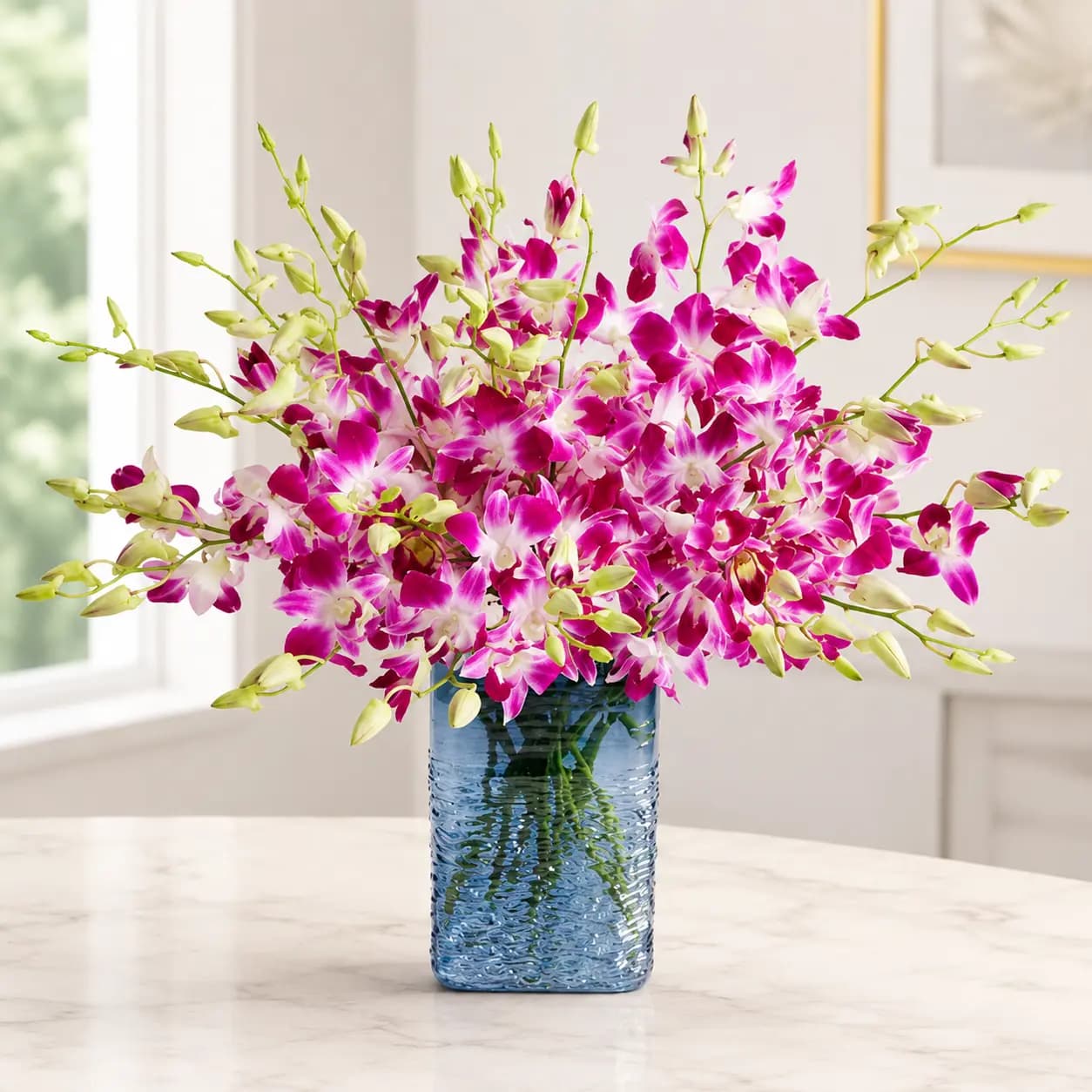
A ready-made design shows how the stem's shape does the work. Purple Orchid Elegance pairs purple Dendrobium orchids with a blue glass vase, a combination that lets the arching stems carry the design. When the palette is limited to one flower and one container, the flowers have to do the talking.
Choosing a container
A clear glass vase keeps attention on the stems themselves. A colored glass vessel adds contrast and can pull the palette toward a room. Narrow openings suit a small number of stems; wide ones suit a fuller, lower look. If the blooms are large and open, keep the container simple, since a busy vessel competes with the flower.
Gifting occasions
Orchids suit occasions that call for something considered rather than casual. They are often chosen for anniversaries, birthdays, thank-you gifts and new homes, and a potted plant works well as a longer-lasting gift. They are also common in sympathy and formal settings, though a mixed arrangement often reads warmer than a single stem.
For a gift that makes a strong impression in a modern setting, Midnight Ocean uses blue dendrobium orchids in a clear glass vase for a bold, contemporary look. The boldness comes from the color, so a simpler setting lets it land.
Because meanings vary by culture and context, the recipient's own preference usually matters more than a fixed symbolism. If you know the person likes a clean, modern look, a strong single-color design works. If they prefer soft and familiar, a mixed bouquet may be the better choice.
Frequently asked questions
How long do cut orchids last?
With fresh water and a cool spot, orchid stems often hold for a week or more, and some types last longer than others. Buds may still open after delivery, so give the stem a few days before judging it.
Are blue orchids natural?
Many blue orchids sold as cut stems are white flowers that growers have tinted with dye. True blue is uncommon in several of the common genera. Ask your florist if the color is natural or added, since it affects how the stem ages.
Do orchids need soil?
Many orchids are grown in bark, moss or a loose potting mix rather than garden soil, because their roots need air. Potted plants also like bright, indirect light and a mix that drains quickly.
For more flowers and plants worth knowing about, visit Great Flowers.